
Checking for a Knox County Warrant
Begin with Indiana MyCase, the public Odyssey case search. A case number is the strongest key. For a ticket, use the citation number. When neither is known, a careful party search helps, though spelling variants and common names can produce false matches. Read the whole picture together: court name, case type, filing date, chronology, hearing entries, and disposition. A line saying a warrant was issued may be old news. Look for a later recall, quash, service, return, or release event before drawing any conclusion. Then confirm the result with the issuing office, because no official full Knox County active-warrant database exists online, so use more than one channel.
- Identify whether the matter is county, Bicknell city, traffic, or federal.
- Search MyCase with the case or citation number first.
- Call the Knox County Clerk or named court to confirm the public entry.
- For Bicknell matters, contact Bicknell City Court; use the Southern District route for federal cases.
- Ask the court or counsel about appearance, bond, recall, or surrender steps.
Skip the sheriff tip form for a personal Knox County warrant inquiry. It gathers facts for investigations and routes emergencies to 911. Note: A public result never replaces the issuing court's current record.
MyCase Has Clear Warrant Limits
Indiana's MyCase help page warns that online information is not the official court record and can contain errors or omissions. The official screen states that limit plainly, without displaying any private person's record.
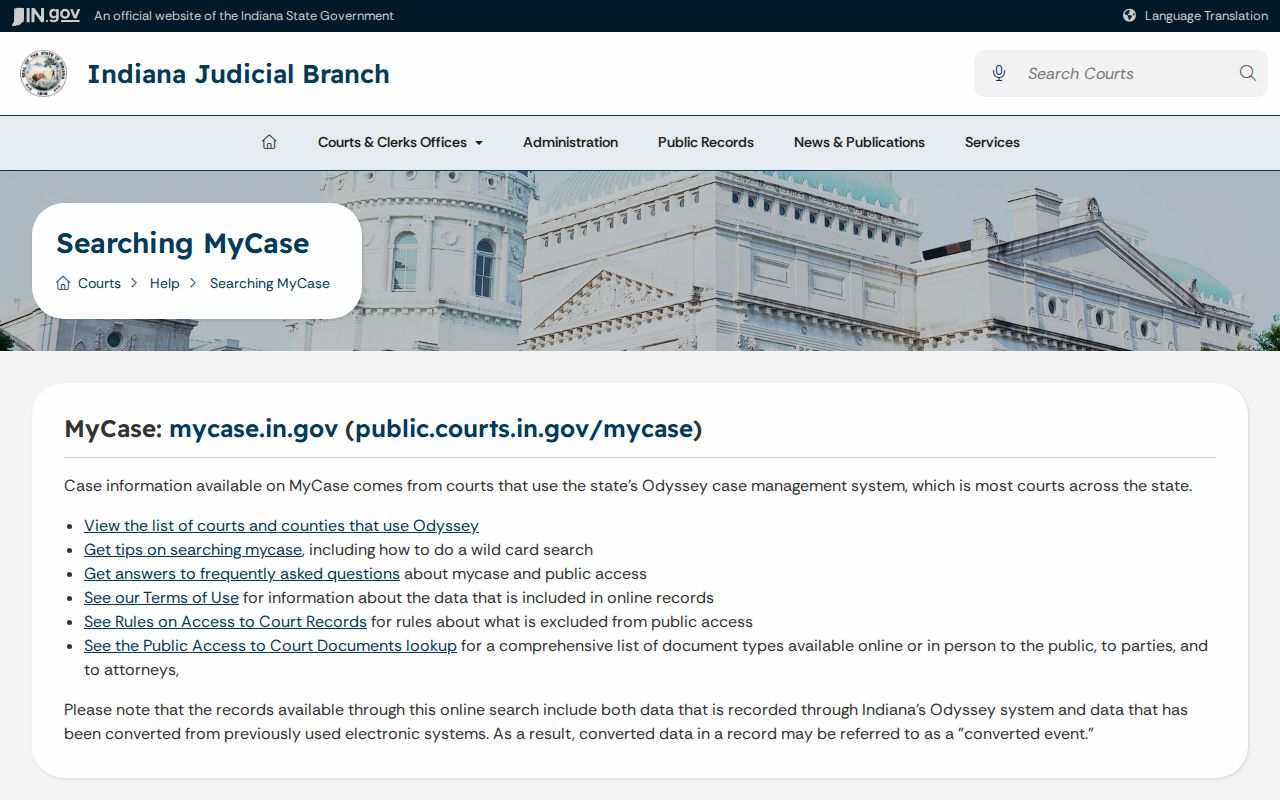
That warning cuts both ways. A past warrant event does not prove present status. A no-result does not prove there is no warrant. Older data, sealed files, confidential cases, name-entry differences, and access rules can all affect what appears. The Knox County Clerk of the Courts keeps the official county trial-court file and can route a resident to Circuit Court, Superior Court I, Superior Court II, or the Magistrate Court.
Knox County Warrant Types
Indiana law and Knox County records use distinct warrant terms. Do not collapse them into one label. A warrant authorizes a specific act under a judicial order.
| Record type | How it arises | Who controls it |
|---|---|---|
| Arrest warrant | A judge finds a lawful basis tied to an alleged offense. | The issuing trial court |
| Bench or FTA warrant | A required appearance or court duty is missed. | The judge who issued it |
| Search warrant | A court authorizes a search for specified evidence. | The issuing judicial officer |
| Summons | A person is ordered to appear instead of being arrested at once. | The named court |
| Traffic FTA or FTP | An appearance or payment issue occurs in an infraction case. | The court, with separate BMV effects possible |
Some places use the term capias. Knox County public sources do not establish it as the local term for fine collection. Use the exact docket wording instead. Failure to pay, a BMV suspension, and an arrest warrant can be related, but they are not the same record.
Search Knox County Cases Precisely
The official MyCase search tips favor a known case, citation, or cross-reference number over a broad name query. The official page shows the case-search route a resident can use before calling a Knox County court.
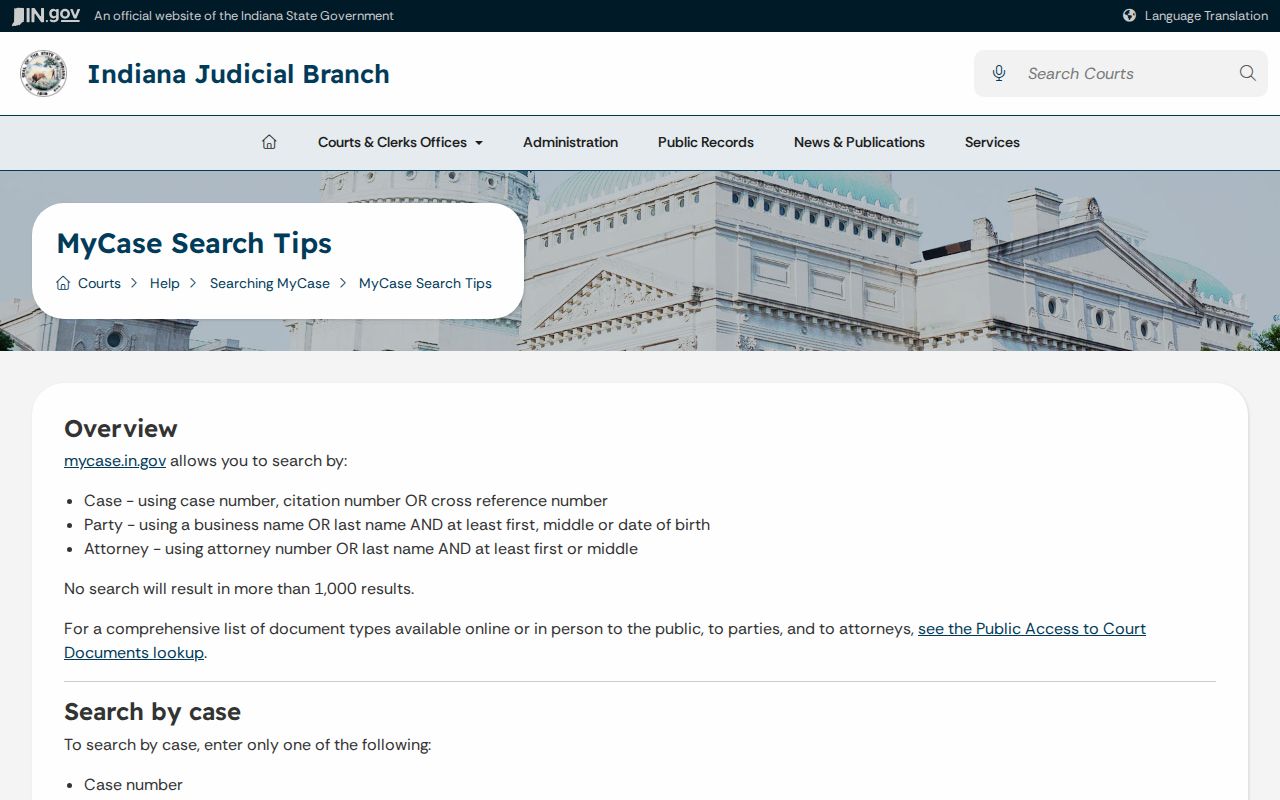
A party search accepts first, middle, and last names, and it may offer a sounds-like option. A trailing asterisk broadens part of a name; a full wildcard is barred. Broad searches can stop at 1,000 results. An empty or capped set is not a complete clearance. If an authorized personal or family search uses a birth date to narrow matches, do not save or publish it. Keep only the case number, court, dates, and public events needed to route the inquiry.
Quick answer: Search by case number first. If it is unknown, use the narrowest name search and confirm every match with the issuing office.
Inside a Knox County Warrant Record
A MyCase result is a case history, not a warrant certificate. The useful fields establish jurisdiction and sequence. Note the case number, court, case type, filing date, party role, hearing date, and the relevant chronological case-summary label. Access rules still govern any public document link.
| Case reference | Case number or exact public identifier. |
|---|---|
| Court | Circuit, Superior I, Superior II, Magistrate, Bicknell City Court, or another tribunal. |
| Event | The exact label and date, without turning an old entry into a current claim. |
| Reason | The charge, missed appearance, or other public basis as written. |
| Bond or release | A reference to confirm under the current judicial order. |
| Status clues | Later service, return, recall, quash, hearing, or disposition entries. |
Never infer an active Knox County warrant from one event. Public data may omit protected material, and operational status can change after the last visible entry. Ask the clerk which court office can confirm the record.
Knox County Public Documents Vary
Indiana's public-document access page explains why some electronic court documents appear and others do not. The official access context is shown, not any private person's case.
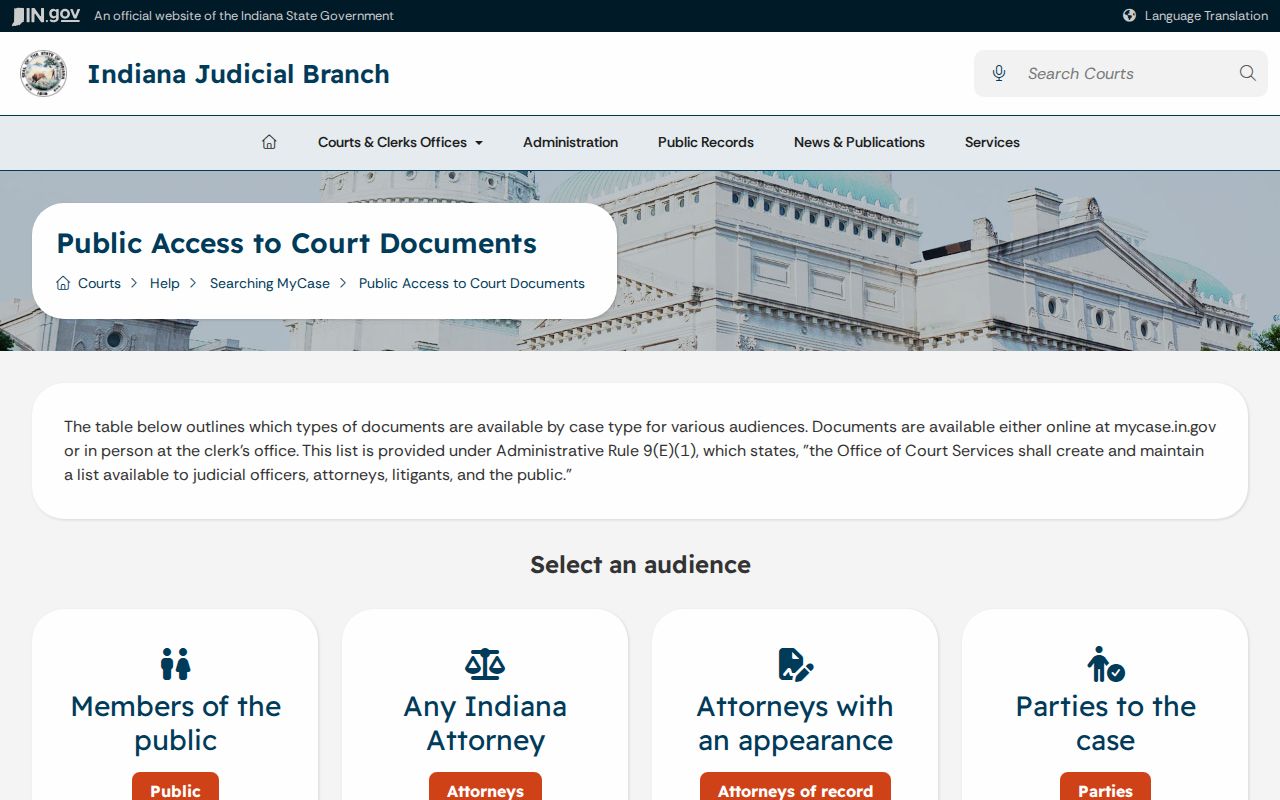
Juvenile, sealed, confidential, victim, medical, financial, and protected identifying data may be withheld. A public file should not become a private-person profile. Knox County residents can request a specific public record. The request should name the agency, record category, date range, and format. Court files go through the clerk and court-access rules, while agency records use the Indiana Access to Public Records Act.
Issuing and Serving Knox County Warrants
Circuit Court and the Superior Courts issue process in their assigned cases. The Magistrate Court handles assigned work, including initial-hearing and bond functions. The clerk keeps the trial-court record. The sheriff executes process and runs public information channels, but does not replace the court as the source of an order.
Knox County Indiana Sheriff's Office
2375 S. Old Decker Road
Vincennes, IN 47591
812-882-7660
The clerk publishes weekday hours of 8:00 a.m. to 4:00 p.m. and clerk@knoxcounty.in.gov. Those details route a Knox County records question. They do not promise disclosure of restricted operational facts or legal advice.
Knox County Court Locations Matter
Knox County splits its courts across two Vincennes locations. Circuit Court, Superior Court I, the clerk, and the magistrate office sit at 111 N. 7th Street. Superior Court II and the in-person traffic-citation payment counter operate at 620 Busseron Street. Check the court name before you travel. Visitors to the courthouse pass through a metal detector. Each division has its own phone line. Circuit Court answers at 812-885-2527, Superior I at 812-885-2517, Superior II at 812-882-4962, and Magistrate Court at 812-895-4910. If your matter may involve arrest, surrender, bond, or a missed appearance, call ahead, since staff can walk you through filing, payment, and scheduling even though they cannot gauge arrest risk or act as counsel.
If You Have a Warrant in Knox County
No online payment, phone call, or list removal clears a Knox County warrant by itself. Only the issuing court resolves it. Depending on the order, the next step may be an appearance, a lawyer-filed motion to recall or quash, voluntary surrender, bond, or a new hearing. Recall means the court withdraws the warrant. Quash means the court sets it aside. Neither happens until the judge acts. Local rules carry an official bond schedule dated 2018. It lists amounts by offense level, though a warrant endorsement or a later order can control instead. Indiana Criminal Rule 2.6 also governs release decisions, and a 2018 schedule cannot say what must be paid today or promise release.
Important: Speak with a lawyer and the issuing office before appearing; only the court can confirm recall, bond, hearing, or surrender terms.
Knox Most Wanted Is Curated
The Knox County sheriff's app carries four buttons: Most Wanted, inmates, MyCase, and Submit A Tip. They are not four equal databases. Most Wanted is a curated program capped at ten entries, with no public search or sort tool behind it. Absence from it does not mean Knox County warrant records are clear. Each entry may show status, reason, offense level, text, or an image. The program lives at its official source. The tip form has one job. It takes information about an ongoing investigation. It is not a warrant lookup, an emergency line, or a surrender channel. The Knox County Most Wanted List explanation spells out these limits.
Knox County Warrant Records and Access
Indiana runs two access systems side by side. APRA governs records held by public agencies. Separate Indiana Rules on Access to Court Records govern court files. Knox County requesters should remember that confidentiality, sealing, and redaction still protect certain information, so a narrow request beats a demand for everything tied to a name.
Key rules:
Indiana Code 5-14-3-3 provides the basic APRA right to inspect disclosable records.
Indiana Code 5-14-3-9 addresses responses and denials.
Indiana Access Rule 4 sets the court-record access framework.
Indiana court access rules identify confidential and excluded information.
State guidance gives an agency 24 hours to respond to a request made in person or by phone. Mailed, emailed, or faxed requests draw seven calendar days. That clock covers a response, not production. When a Knox County office withholds material, ask for the legal basis. Note: APRA does not override a sealing order.
Save Knox County Case Details
Write these down before you call a Knox County office. You want the exact case or citation number, the court name, the public event date, the event wording, and the next hearing shown. Those details let staff find the file fast. Leave private addresses, birth dates, victim facts, and unrelated narrative out of your notes.
- Warrant event
- A docket entry that needs current confirmation.
- Failure to appear
- A missed required appearance that may lead to court process.
- Recall
- A court action withdrawing a warrant.
- Summons
- A command to appear that may be used instead of immediate arrest.
- BMV suspension
- A driving-privilege result that is not proof of an arrest warrant.
Federal and Tax Warrants Differ
Federal matters touching Knox County route through the Southern District of Indiana. Its Terre Haute courthouse serves the county. PACER opens the dockets, but sealed warrants can stay hidden before service. It is not a live warrant checker. A no-result search proves little. Indiana e-Tax Warrants is a different system, and a tax warrant is a collection record rather than a criminal arrest or traffic warrant. Indiana eCWS is citation infrastructure shared by agencies, courts, and the BMV. It is no public warrant list. Keep these systems apart when you seek Knox County warrant confirmation.
Knox Traffic Records Need Two Checks
A Knox County traffic matter can stack up fast. One file may hold a citation, a court case, a missed appearance, an unpaid balance, and BMV action. The events connect, but none proves the others. The Knox County clerk sends online payments through Indiana ePay Public Access and lists 620 Busseron Street for in-person traffic payments. Confirm the citation is eligible first. Keep the citation number and your receipt. Ask whether an appearance or separate court order is still required. In Knox County, a failure to appear or failure to pay can affect driving privileges. Before BMV updates its record, the court must send qualifying notice, and other restoration terms may apply. Payment does not recall an arrest or bench warrant. It does not promise instant license restoration either. The issuing court explains its docket, and BMV explains the separate driving-privilege record. A reminder text is not an official warrant notice, even when a court joins Indiana's Odyssey reminder program.
Knox County Warrants by City
Knox County's five largest incorporated places are Vincennes, Bicknell, Oaktown, Monroe City, and Wheatland. City limits do not pick the issuing court. Bicknell alone has a listed city court. Vincennes posts a verified police contact, while the other towns offer no dedicated public warrant portal.
Begin the Knox Warrant Lookup
The official Indiana MyCase portal is the public starting screen for a Knox County warrant lookup. It returns case listings by name.
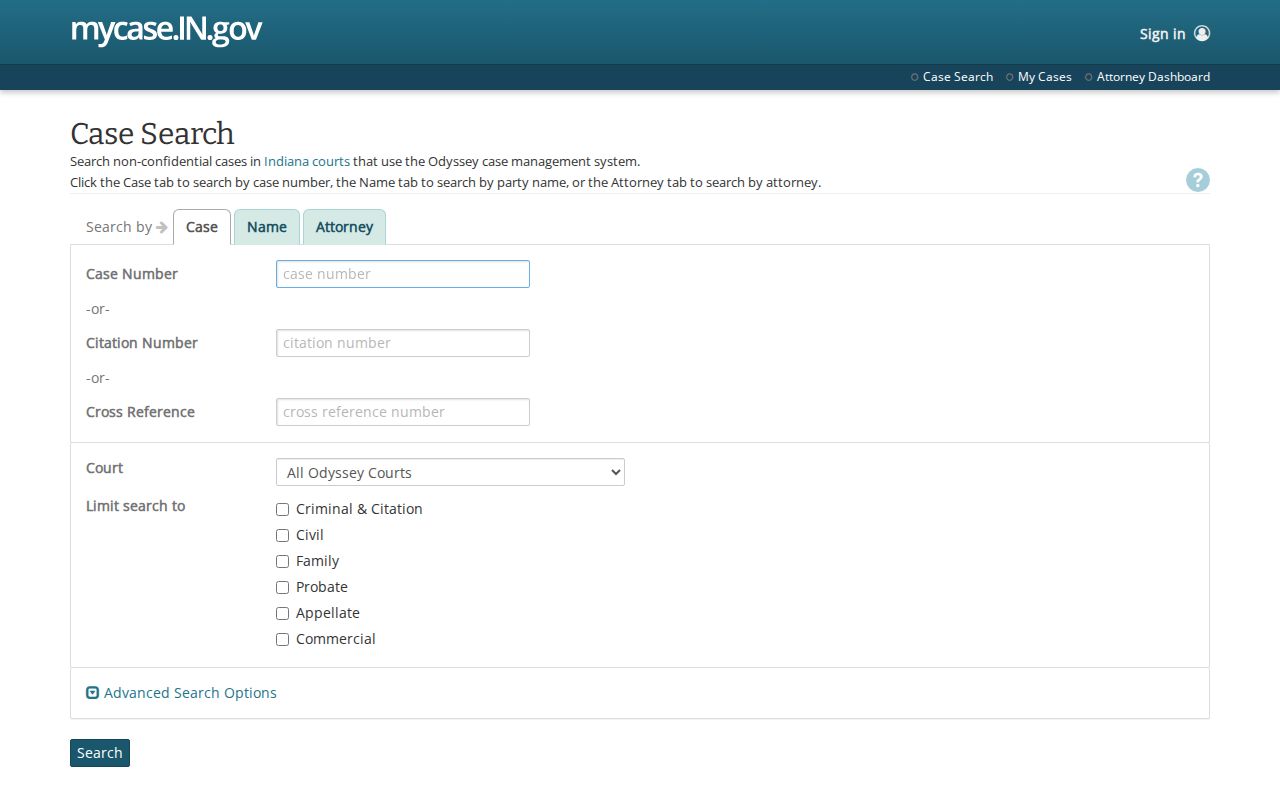
Use it to spot a likely court and case. Confirmation comes next. In Knox County, the clerk locates the official county file, the court addresses its own order, and the sheriff explains its contact channel, so no online screen should be overstated.